- Working hours: MON-FRI 9:00 - 18:00

Surface wastewater
Closed-type treatment plants for contaminated surface wastewater
General characteristics
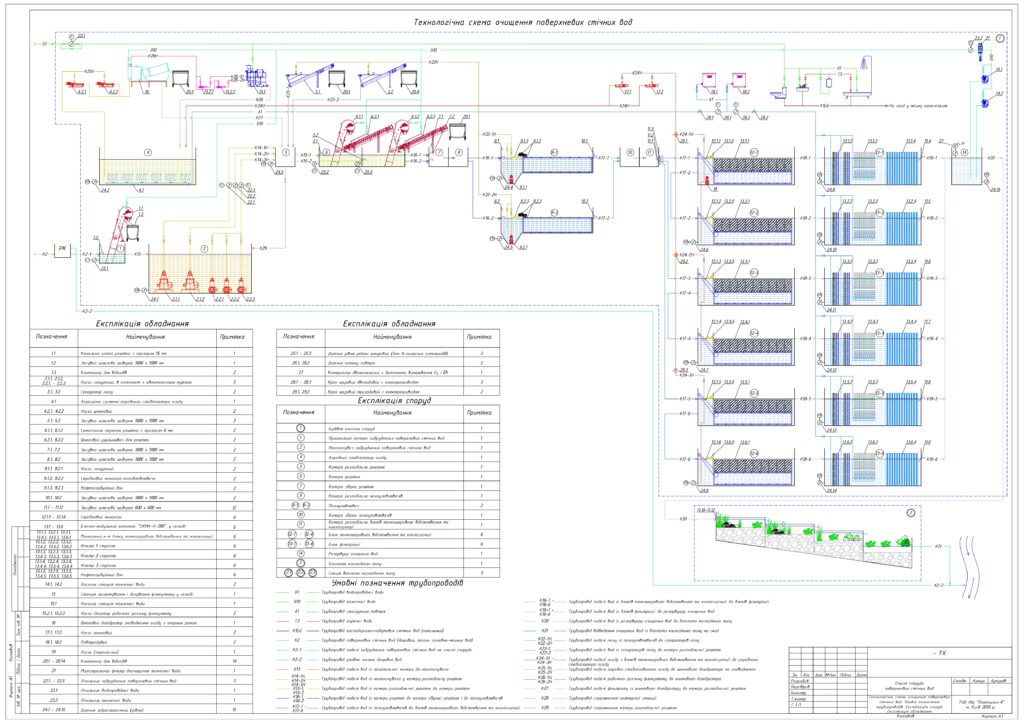
Closed-type contaminated surface wastewater treatment plants include the following units:
- mechanical cleaning unit for coarse waste on grates;
- sand collection unit;
- thin-layer settling, coalescence and filtration unit;
- secondary treatment unit at the phyto-treatment complex "Bioplato cascade type";
- mechanical dewatering unit for sand and sludge.
Mechanical cleaning on grates
Contaminated surface wastewater from the distribution chamber enters the treatment plant building, namely the receiving chamber for contaminated surface wastewater, where a channel grate with a transparent 16 mm is installed to remove coarse impurities and debris, which allows you to protect the pumping equipment from overloading and blocking.
Mechanically cleaned water from debris enters the contaminated surface wastewater storage tank, in which submerged pumps are installed. In order to save energy, it is planned to turn on the pumping equipment alternately according to the signal from the hydrostatic (level) sensor.
Submersible pumps deliver wastewater to the grid distribution chamber and then to the 6 mm transparent channel grids installed in the grid chamber.
Sand capture and removal of petroleum products
Water mechanically cleaned of impurities larger than 6 mm enters horizontal sand traps with a settling section and pits.
Grit traps are equipped with oil sorption booms to remove floating oil products.
The sand that settles to the bottom of the sand traps is moved by scraper mechanisms into pits, from where it is fed to the sand separators by submersible pumps. The water separated from the sand is discharged for re-purification.
Thin-layer settling and coalescence
Water purified from sand and floating oil products enters the thin-layer settling and coalescence units, which operate in parallel.
Each tank is equipped with scraping mechanisms and oil absorption booms.
The water flow moves through the thin-layer sedimentation tanks from bottom to top. The sediment moves against the movement of the main flow - from top to bottom along polypropylene plates inclined at an angle of 60°, and then, using scraper mechanisms, it is moved to the sediment intake zone by self-priming pumps, which pump the sediment into the aerobic sediment stabilizer.
Sludge stabilization and dewatering
The sludge in the aerobic stabilizer is stabilized using air supplied from air blowers and is fed by self-priming pumps for dehydration to the screw dehydrator, where the working solution of the flocculant from the polymer station is also supplied by dosing pumps.
The dewatered sediment is unloaded into containers, and the filtrate is returned for re-purification.
Filtration and biological treatment
From the thin-layer settling and coalescence units, water enters the filtration units equipped with:
- filters made of polypropylene biofiltration materials with a specific surface area of 190–365 m²/m³ and 120–150 m²/m³;
- sorption filters made of polypropylene fibers.
Filters are purged periodically with air supplied from air blowers in semi-automatic mode.
During the start-up period and after each tank emptying, a biological preparation is introduced into the filtration units for cultivation on the loading surface of facultative microorganisms that biodestruct dissolved organic pollutants and petroleum products.
Oil sorption booms are replaced periodically (approximately 4 times/year).
Sorption filters are designed for additional treatment of surface wastewater, the material is replaced once every 5–10 years. The frequency of replacement of spent materials depends on the actual amount of surface wastewater, taking into account climatic features and the actual level of contamination of the effluent with petroleum products.
Purified water reservoir and supply to the Bioplato
Purified water from the filtration units enters the purified water tank, from where it is drained by gravity from the treatment plant building into the "Cascade-type Bioplato".
Further purification in the phytopurification complex "Bioplato cascade type"
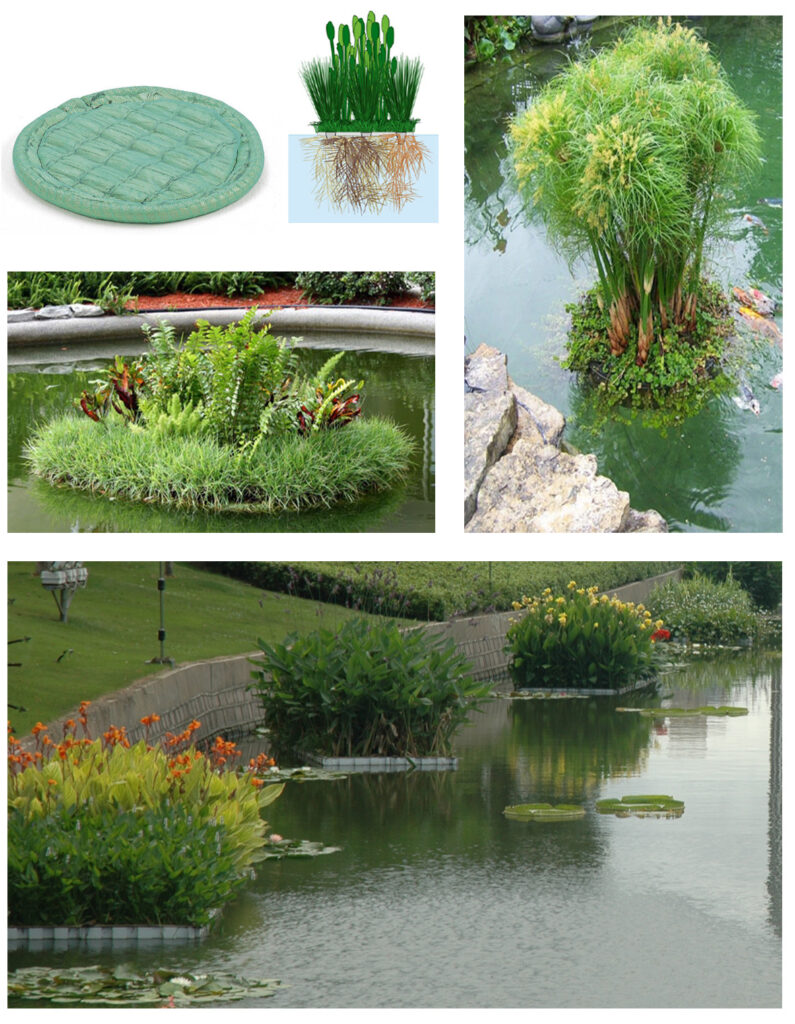
Water purification at Bioplato is carried out by immobilized microorganisms-biodestructors, other hydrobionts of different trophic levels, higher aquatic plants (reed, reed, cattail), moisture-loving and ornamental plants (iris, calamus, sedge, sedge, and others).
The cascade-type bioplateau includes three parallel four-tier sections. Water is supplied to each section through a gate valve.
The open-type "Bioplato" design provides a water mirror, made using:
- crushed stone of fractions 40–70 mm;
- pebbles of fraction 80–120 mm;
- river boulders 300–500 mm in size.
A bacterial biodestructor preparation is added to the load.
Water movement occurs in horizontal and vertical directions.
The designs of the tiers contain slots in the sides, which provide natural aeration of the water due to gravitational forces and the creation of turbulence.
The design of the bioplateau involves preventing it from drying out during periods of lack of water and precipitation and regulating water levels in the layers.