Drum screens are wastewater treatment equipment used to remove small and medium-sized mechanical impurities. They are widely used in wastewater treatment plants, helping to improve water quality before subsequent treatment stages.
Such screens have the shape of a rotating drum, the surface of which consists of a mesh or perforated material with holes of a certain size, water passes through these holes, and solid particles are retained on the surface.
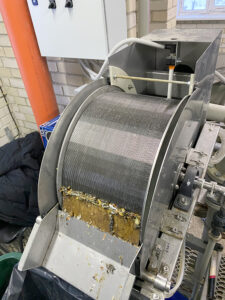
The principle of operation is that wastewater is fed to a drum that is constantly rotating. During the rotation, contaminants remain on the grid and gradually move to the cleaning zone, where they are washed off with water or removed with special brushes. After that, the waste is removed from the installation.
Drum screens allow for the effective retention of fine particles that cannot be removed by conventional screens, so they are often used as the next stage after rough cleaning.
The main advantages are high efficiency, cleaning, automatic operation, compactness and reliability, they can operate without constant human control and provide stable results.
Disadvantages include the need for maintenance, possible grid clogging, and higher cost compared to simple grates.
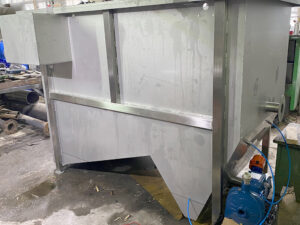
Drum screens are used in municipal wastewater treatment plants, industrial enterprises and in purification systems where a higher level of filtration is required.
Therefore, drum screens are an important element of modern wastewater treatment systems because they ensure effective removal of fine impurities and improve the quality of water purification.