Treated water is discharged into surface water bodies or into the groundwater flow, depending on the location of the structures and the filtration characteristics of the underlying soils.

The closed hydroponic bioplateau is designed for deep purification and drainage of pre-treated household, industrial and rainwater return water into the groundwater flow or into surface water bodies.
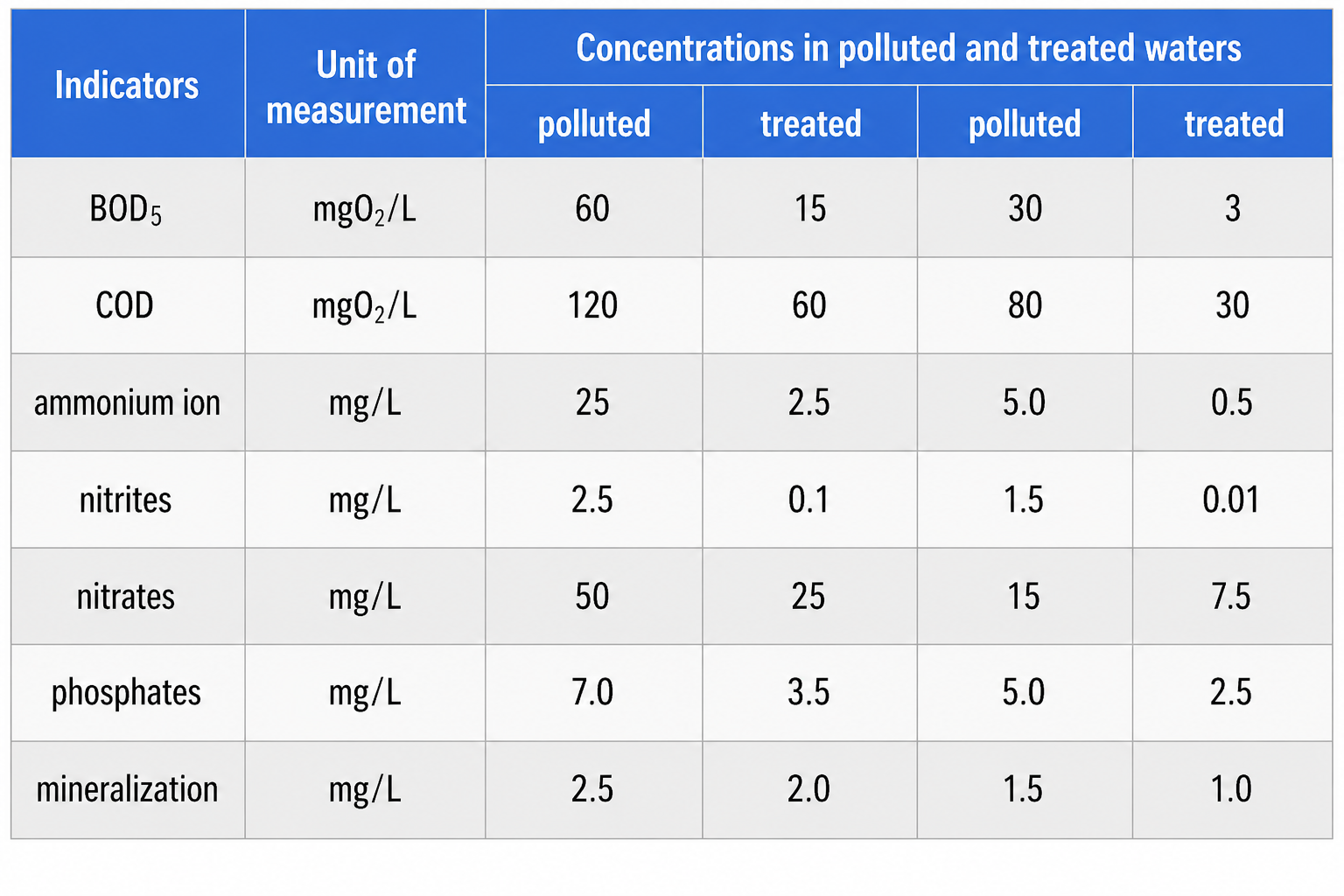
The closed hydroponic bioplateau must be supplied with water free from suspended particles (≤40 mg/l). The concentrations of pollutants in the return water entering the bioplateau must not exceed:
The capacity of the bioplateau depends on the quality of the pre-treated water and its volume. The load on the bioplateau ranges from 1 to 4 m3 of return water per 1 m2 of area per day.
All piping systems (distribution and collection) are made of polyvinyl chloride or polyethylene pipes.
The loading of the bioplateau drainage layer consists of inert material (e.g., washed crushed stone) with a particle size of 40-70 mm, into which a biological preparation is introduced with microorganisms immobilized on an inert carrier (e.g., peat) that destroy petroleum products, fats, oils, and other organic substances (SPAR, pesticides, herbicides, etc.). The biological preparation (e.g., "Econadin", "Trofoil") promotes the sorption and destruction of organic substances, improving the sanitary indicators of water quality; it is poured directly into the drainage layer in the places where higher aquatic plants are planted, which promotes their growth.
On top of the drainage distribution system covered with crushed stone, a 40 mm thick insulation (e.g. polypropylene, basalt fiber) is laid, which does not interfere with the germination of higher aquatic plants. The insulation is covered with a layer of crushed stone on top.
Planting of higher aquatic plants is carried out in a drainage layer of crushed stone at the level and along the upper drains. Common reed, lake reed, narrow-leaved cattail, marsh calamus, etc. are used for planting.
Treated water is discharged into surface water bodies or into the groundwater flow, depending on the location of the structures and the filtration characteristics of the underlying soils.