Containerized ICBM

Modular wastewater treatment plants of the BMC "BRAVO" with a membrane biological reactor (MBR)

Purpose and scope of application

Modular wastewater treatment plants of the BMC “BRAVO” type with a membrane biological reactor (MBR) of complete factory readiness.

The structures are designed for wastewater treatment that has special quality requirements, both in terms of chemical and bacteriological indicators, when discharged into the environment or city sewerage. It is economically feasible to use the structures of the BMK “BRAVO” for wastewater treatment of infectious departments of hospitals, dispensaries, other medical institutions, wastewater with an increased level of pollution compared to the average household wastewater.

The structures of the Block Modular Complex "BRAVO" use the Sterapore SUR234L membrane module, manufactured by Mitsubishi Rayon (Japan) with a pore size of 0.4 microns.

Collaboration and scientific approach

Cooperation and exchange of experience with scientific centers and leading world manufacturers of water treatment equipment allows us to comprehensively solve complex tasks in the field of water drainage and wastewater treatment.

In their work, specialists of the Potential-4 Scientific and Engineering Center use the latest achievements of scientific and technological progress in the field of wastewater treatment, sludge utilization, and progressive domestic and imported equipment.

Membrane bioreactor (MBR) technology

The technology is implemented in the block-modular complex of the Bravo BMC, and combines the processes of biological treatment of wastewater from organic contamination by aerobic microorganisms of activated sludge and the separation of purified water from activated sludge on ultrafiltration membranes.

Aeration is carried out with compressed air using aeration systems. Depending on the required performance, membrane modules are combined into a membrane block. The number of membrane modules in the block can be increased if there is a need to increase the system performance.

Since suspended solids do not leave the system during the clarification stage, it is possible to have full control over the residence time of the water and solid phase…

Advantages of container construction

Since suspended solids do not leave the system at the clarification stage, it is possible to have full control over the residence time of water and solid phase (activated sludge microorganisms and suspended particles of the initial wastewater) in the reactor, as well as separate control of activated sludge growth and hydraulic residence time.
МБР контейнерного виконання

This allows you to radically change the parameters of the operation of biological reactors - to accumulate in the reactor increased concentrations of activated sludge, including slow-growing species of microorganisms (nitrifiers, microorganisms that oxidize bioresistant compounds), to increase the growth of activated sludge at high hydraulic loads on the bioreactor (short residence time of the source water). Detention of suspended particles of the source water in the bioreactor prolongs their contact with microorganisms until complete biological destruction. Thus, biocenoses adapt well to fluctuations in the concentrations of pollutants in the source water and are independent of the sedimentation characteristics of the activated sludge. As a result, the stability of the system increases.
The “cut-off threshold” of activated sludge microorganisms on membranes allows specially bred strains of microorganisms resistant to the action of bioresistant substances and disinfectants to be cultivated in the conditions of the MBR system.

Disinfectants that have a detrimental effect on activated sludge bacteria in flow-through treatment systems are successfully decomposed in the bioreactor without causing loss to the adapted microflora and without interfering with the treatment process.

Since activated sludge microorganisms do not penetrate the ultrafiltration membrane, water purified in the MBR system is bacteriologically safe.
Bioreactor operation and maintenance

The membrane bioreactor operates in conditions of high concentration of biomass of considerable age, while the main energy consumed by bacteria is used not for reproduction (as is the case in classical biotechnology), but to support life, which leads to a decrease in the growth of excess active biomass.

Membrane unit flushing is carried out two to four times a year as a preventive measure, as well as before a long stop in operation, during seasonal operation. Thus, flushing is a simple auxiliary procedure in terms of costs and impact on the operation of treatment facilities. Due to the almost complete retention of microorganisms in systems with a membrane biological reactor, the following parameters of the biological treatment process change:

  • The concentration of activated sludge increases (3-4 times compared to classic technologies with aerotanks), this leads to an equivalent reduction in the volume of bioreactor tanks;
  • Complete retention of bacteria in the volume of bioreactors is ensured, which allows the cultivation of slow-growing but effective bacterial species for water purification;
  • The growth of microorganisms and the amount of excessively active sludge that needs to be removed from the bioreactor are reduced (by 2-3 times compared to classic technologies with aeration tanks);
  • The quality of wastewater treatment increases compared to classic technologies with aeration tanks, while secondary settling tanks and post-treatment filters are not required;
  • Disinfection of purified water is carried out;
  • Reliability and high efficiency of wastewater treatment from suspended solids are ensured, since emergency situations associated with sludge entering the treated water are impossible.

Bioreactor operation and maintenance

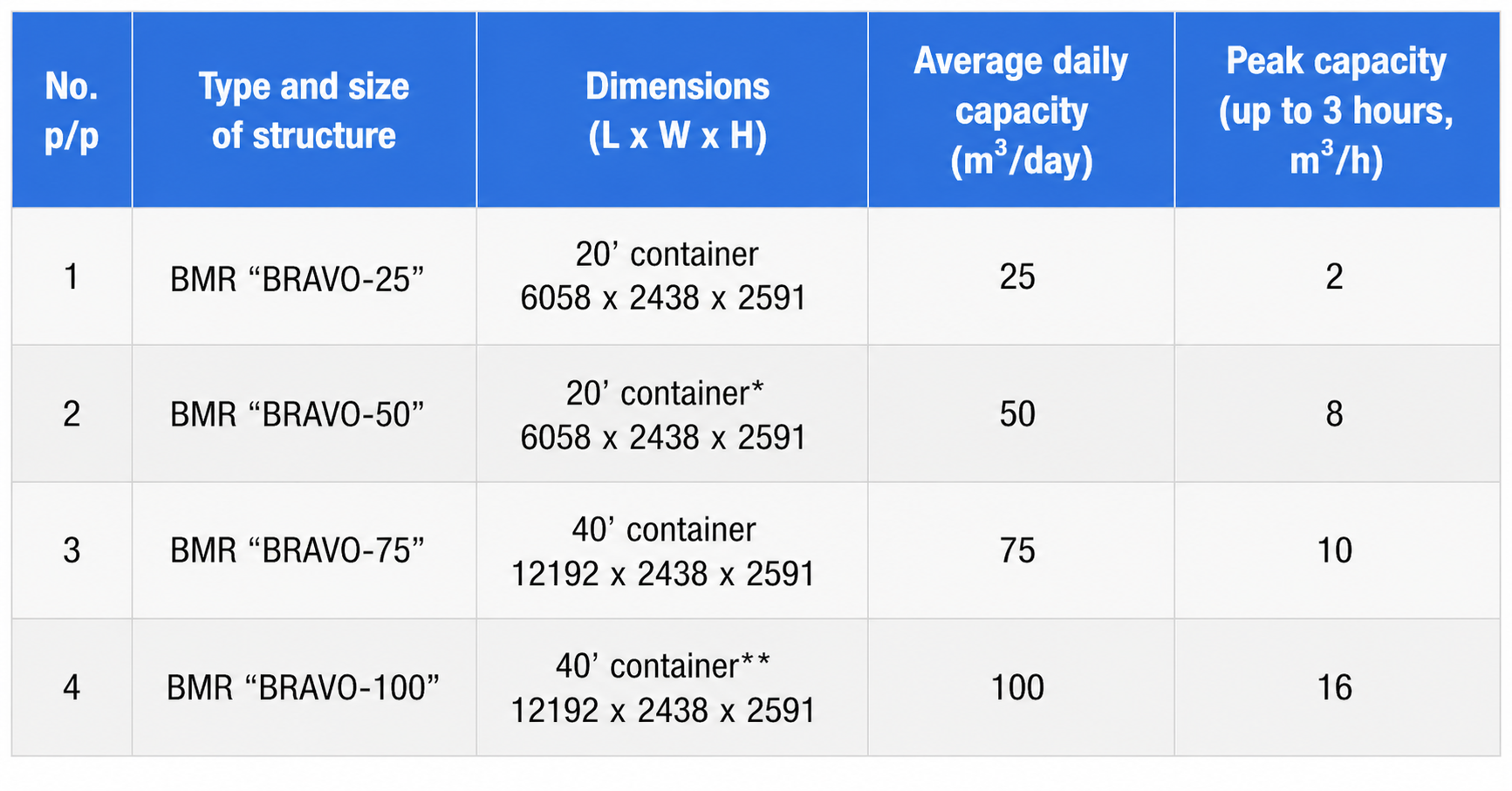
* – when equipped as a storage / denitrifier tank with a volume of 25 m3
** – when equipped as a storage / denitrifier of a reinforced concrete tank with a volume of 50 m3

Ultrafiltration

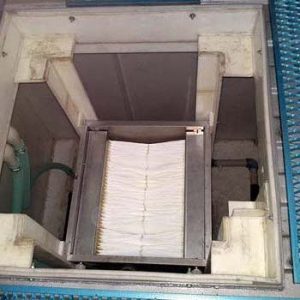
Separation (filtration) of activated sludge from biologically treated wastewater in the BMK “BRAVO” with MBR is carried out by hollow fiber ultrafiltration membranes immersed in the bioreactor - nitrifier. The sludge mixture is filtered through the membrane (in the direction from outside to inside), due to the discharge created inside the fibers.

The confirmed service life of the Sterapore SUR234L membrane elements manufactured by Mitsubishi Rayon (Japan) installed in the BRAVO MBR plant is at least 7 years. The disinfection scheme in the BRAVO MBR plant is three-stage.

The first stage is the retention of 99% of microorganisms on the ultrafiltration membrane of the module, the second is disinfection using ultraviolet lamps with radiation at a wavelength of 256 nm. Ultraviolet disinfection of water purified using MBR technology is particularly effective due to the high transparency of the ultrafiltration membrane filtrate.

In this case, the main purpose of ultraviolet disinfection is to destroy viruses, the small size of which allows them to pass through the module membrane, the third (if necessary) is final disinfection with sodium hypochlorite or another disinfectant.

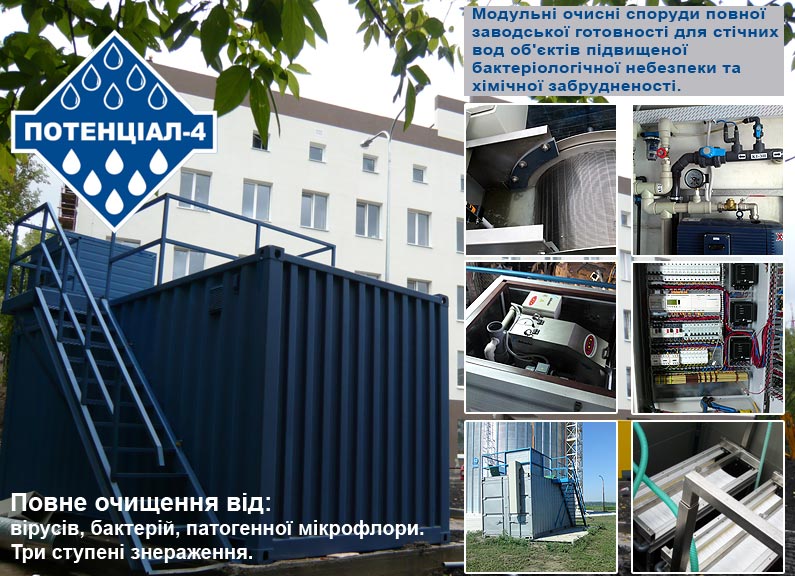
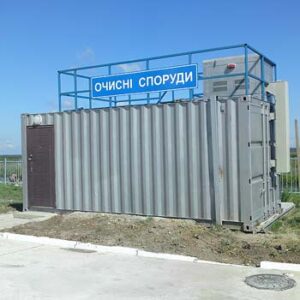
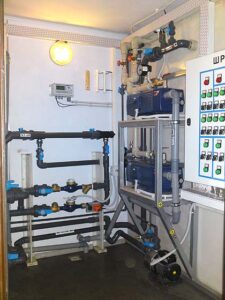
In order to reduce construction time and ensure prompt commissioning, we offer the delivery of a fully factory-ready block wastewater treatment plant in the form of a block box with the transport dimensions of a standard 20-foot (or 40-foot) container. The container is installed on a monolithic slab made of reinforced concrete.

Equipment

Needed
help?